

What do you do after you abandon what you thought were your dreams? How do you go back to a life after lofty ambitions carried you as far as they could? How do you transition from the idea that life should be more than it is, to accept that it is already enough?
I quit my scientific post and moved back to Edinburgh, with a lot of questions still unanswered. It all went very fast. I got a job in the biomedical industry for which I was well qualified, and just like that, I had traded my dreams of academia for a corporate nine-to-five job.

Coming out of deep burnout, I needed the change of pace. I could leave work at work, I had a good salary and benefits, and I never needed to work long hours. For a year or two I convinced myself that was good enough.
I wasn’t happy, necessarily, though I felt like I shouldn’t complain. Yet something fundamental was missing. Despite developing treatments for rare genetic disorders – which on paper I thought should feel deeply meaningful – I felt like all I was doing was to feed a money-making machine. I wasn’t working on projects I had any say in. I felt detached from the world and the people I was supposedly doing this for. I was simply putting the hours in, collecting the paycheque, enriching shareholders, and going home. Rinse and repeat.
My soul was eroding. The fuel through which I’d powered my life and soul had been ambition, though it had also been that insatiable urge to prove myself that burnt me. But now the tank was empty; I had no reason, no drive – I felt more than bored.
I didn’t feel alive.
I was burning out all over again through lack of purpose. My brain still had some of its old patterns of course. It’s hard to move away from the idea that to live a meaningful life you have to do something grand that’ll leave a legacy. So I was questioning my every thought and feeling, thinking this is what a life of ‘enough’ looks like, and that I shouldn’t be ungrateful. I was afraid of reverting back to old patterns of proving myself.
But I slowly realised I wasn’t being true to myself and my own interests. I wasn’t learning, connecting, being creative, coming up with ideas and building upon them, all of which were things I used to enjoy. I began to sense that I needed to take some time to figure myself out. Maybe start writing again. But I was at the same time too afraid to give up the stability and safety I had built.
I was afraid of what it might mean to leave it all behind. Despite leaving academia, I was still doing science. There was still a small tether to my old dreams. Having spent fifteen years working for something, I didn’t want to just walk away. Would it mean I had wasted all of those years? The finality of leaving it all behind was terrifying.
The very idea felt like leaving all the safety of the shore behind, and casting off for the open sea with no idea what was in store. Maybe if I had remembered the words of Herman Melville I would have been able to do it earlier:
But as in landlessness alone resides highest truth, shoreless, indefinite as God- so better is it to perish in that howling infinite, than be ingloriously dashed upon the lee, even if that were safety!
-Herman Melville, Moby Dick
I was too scared of facing the open seas – to perish in that howling infinite – and looked to the false safety of the lee shore for so long that I forgot how to be a human, free of mind and spirit.
I was in the third burnout of my life, living in beautiful Edinburgh, Scotland, without seeing the world around me. It felt like a shadow realm where nothing was enjoyable, and I had no desire to do any of the things that used to bring me joy. I didn’t spend much time outside; I didn’t read, nor socialise much; I wasn’t writing, or sailing, or being creative in any way.
But then – through some cosmic serendipity I still don’t fully understand – a fellow burnt out sailor at a local yard gave me his sailing boat. She was sitting neglected in the yard, slowly rotting away. Her name was Kismet, meaning destiny. It still seems too good to be true. I don’t believe in preordained destiny or interventionist higher powers influencing reality, though I’ll take a gift from the universe when it arrives.
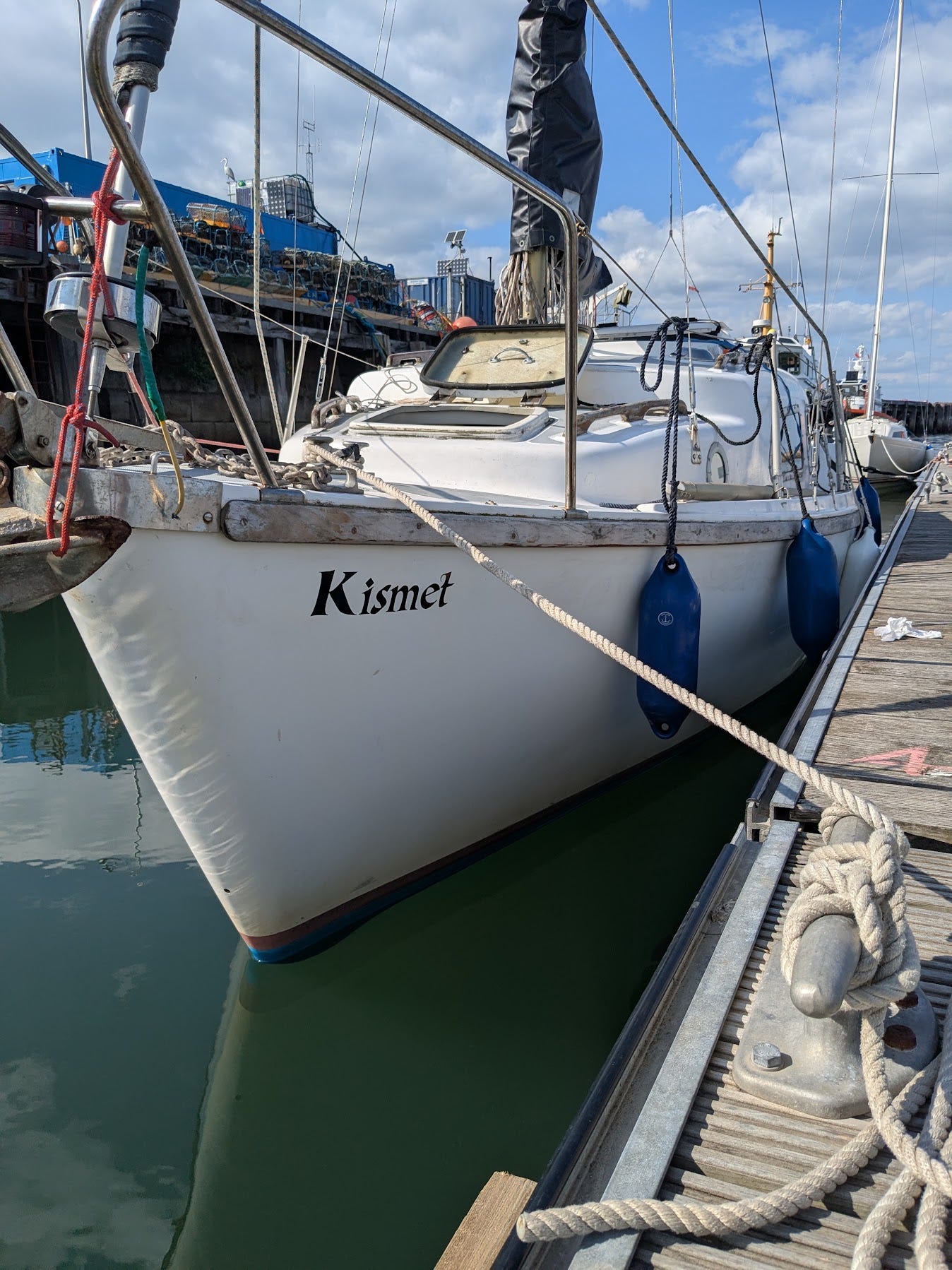
She lit a faint spark in me. Slowly – through the soullessness and turgidity of my mind – ideas started forming, and ambition started returning. But not an ambition to prove myself. An ambition to do something honest for myself. To cast off and sail into the open seas, metaphorically and literally, to find a way back to myself. To find my lost soul, and to find my humanity again.
And with that ambition I started feeling more alive again. Alive to pursue curiosity and adventure. The plan that began forming was to learn to fix up Kismet, rebuild the diesel engine, and refurbish her entirely, and then set sail. Sail as far as I had to until life made sense again.
And I did. I restored that little boat and I sailed her around all of Scotland. I spent months with bleeding, oily knuckles rebuilding a rusted diesel engine, before cruising around ancient islands and anchorages with puffins and seals as neighbours.
It was creatively challenging, and conceptually exciting. But more than anything I had time to myself, working with my hands, immersed in difficult projects. And when we sailed, I was slowly transformed. I started sensing how the slow living – the attention I could pay to myself and my surroundings, and the closeness to the natural world – shifted my thoughts and perceptions.
I found the balance I needed between ambition and self worth. I see now that I can be ambitious still. But I don’t seek validation like I used to; instead I seek connection. This ambition is quieter, not as hungry. It doesn’t define my value anymore, it just fuels my love for the world and all that it holds.
Somewhere along the way I noticed I was no longer burnt out. I felt fulfilled and content. For once, I heard the world and the wild geese announcing my place in the family of things.
And now I can look back at my life and finally see that I have always been enough. I will always be enough.
Thank you for being here and reading. Sharing this story has been a raw and incredible experience, and I feel certain I’ll come back to it for myself when things ebb and flow in life, just to remind myself of where I’ve come from. I hope it can do the same for you.
I’m in the process of trying to publish my memoir covering my journey from burnout to sailing in detail, along with the circumnavigation of Scotland. If you want to follow along, please consider becoming a free subscriber by clicking the button below. Your support means the world to me.
If you would like to support me and Kismet with a small donation you can join as a paid subscriber. You currently get 20% off an annual subscription.
https://www.alexandergunnarsson.com/JoinTheCrew
A note: The line “announcing your place in the family of things” is from the beautiful poem “Wild Geese” by Mary Oliver.
Previous parts in this trilogy:


What a beautiful reminder that we can break the chains of corporate culture and live again.
What a beautiful metaphor. Kismet wasn't just waiting to be restored, she was quietly restoring you too. I loved this. Wishing you every success with the memoir. X