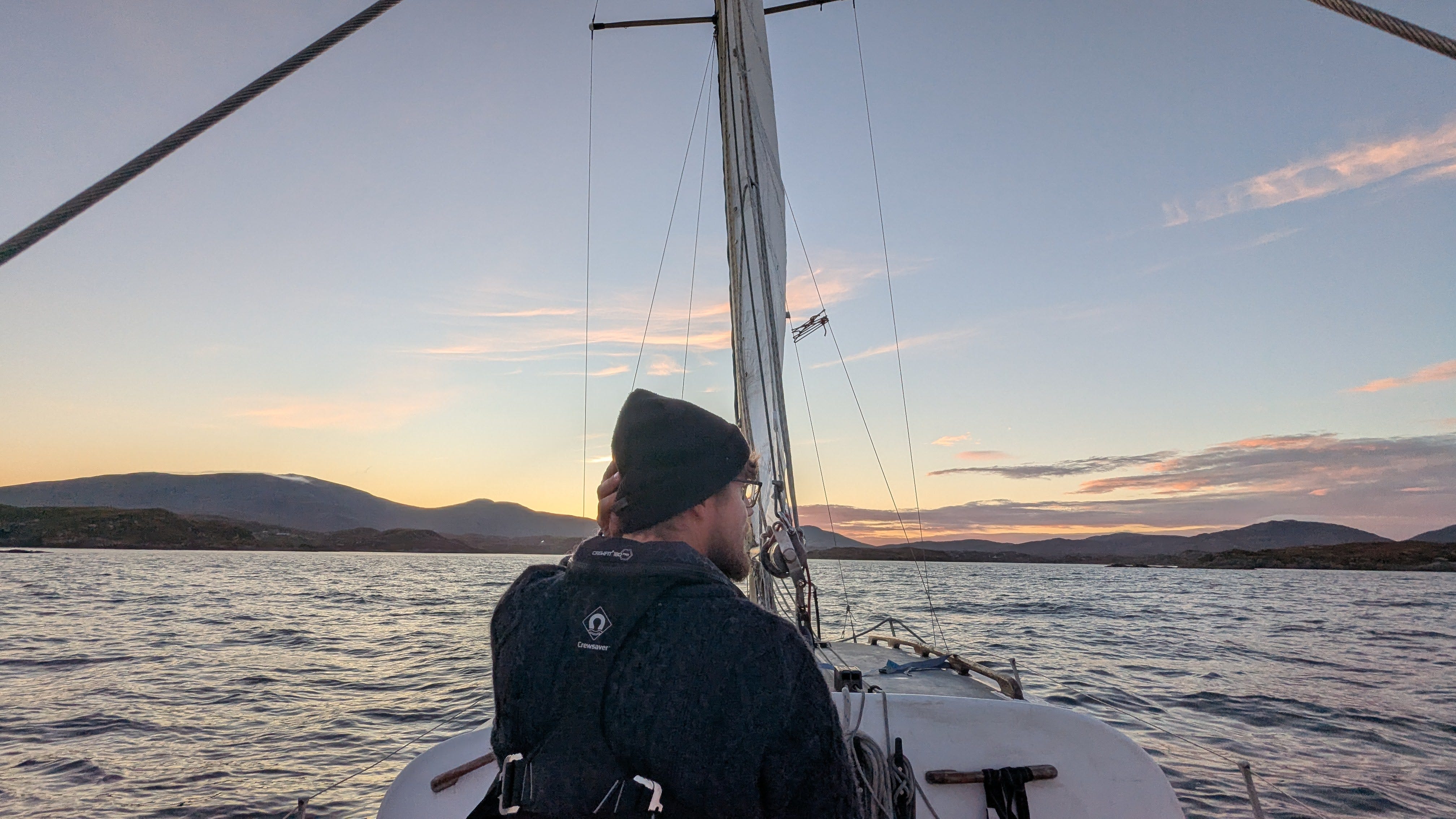
Sailing a small sailboat as the sun sets and the cold descends, leaving you alone and vulnerable
Prologue
I am alone at sea in my small sailboat after leaving Edinburgh at first light, and am now somewhere east of St Andrews. I am in search of something, or perhaps trying to escape as I sail my little ship Kismet – a twenty-three-foot sloop – single-handed for the first time. I’m seeking adventures along the coast, heading north to see how far I can make it – an ambitious trip for so small a ship. The azure sky is filled with gannets, gracefully cruising in search of food, and in the water, puffins drift lazily, their colourful beaks reflected in the still surface. I’m trying to make my way to Stonehaven, a few hours further north, with tide and wind.
As I close my eyes and let the movement of the boat carry me, I sense the power of the elements that move me. I feel the ceaseless power of the tide that flows like a great oceanic river, carrying me north, and the tentative brush of wind, fickle and unpredictable. It is calm now, but these forces are like great, wilful spirits of the earth, and they are in charge of life at sea. If they so choose, there is no fighting, nor harnessing their inexorable power, one can just hope to endure.
But occasionally, like now, they let you in, allow you to coexist in their domain, and in a small sailboat borrow some of their power. And when tide and wind and waves all harmonise with your little ship there are moments like this: a union of pure magic. In this union is the truest form of peace that I know: it is when I become one with the rhythm of the sea, of the regular movement of the waves and tides, and when the gusts and lulls of the wind flow and merge and become an extension of my senses.
This feeling is what I am searching for as I keep sailing northward, bow pointed towards Orkney and Shetland. But unfortunately, the wind has just died and it’s drawing late into the afternoon. The sails are flapping gently in the occasional breeze. I go down below to make myself an early dinner in the light of the setting sun. I’m at peace in my little ship, enjoying the solitude, and the distance to land based life; enjoying being surrounded by sea and birds, far from it all. I turn the stove on and start preparing some pasta.
I’m eating down below when I sense our movement changing; the wind is finally picking up. It hums in the rigging as we start surging forward. I quickly finish the food and climb back out on deck to take control of the tiller. We are sailing! We are picking up speed and the bow is splitting the water into two waves, leaving a long wake that merges into the wavelets behind us.
The wind rapidly increases in the dusky evening light, and the rigging and sails are straining under its force. I’ll need to reduce sail before something breaks. But as I go to furl away my headsail, something is wrong: it’s completely jammed. A lump of fear grows in the pit of my stomach. I try again, but no matter how much I coax and pull, it won’t budge. I scramble up on deck and head to the bow, carefully balancing as I walk in the increasingly difficult conditions. I’m trying to get the sail mechanism free, yanking and twisting with increasing desperation and force, but nothing is helping. Then snap! A bolt breaks and the whole forestay, which is holding up the mast, comes off from the bow. Shit! Somehow the mast is still standing, but the forestay is swaying wildly, risking serious damage. My hands are shaking as adrenaline surges through me and I try to hold on to the swaying stay.
For a moment I look out behind me. The sky is caught in a vivid orange, as the setting sun blazes through the atmosphere, and the beauty of it stuns me. Then, the sail is whipped furiously by a strong gust, and I’m almost thrown over the side by the force of it. With perilous effort I wrestle the mass of canvas and lash it around the forestay. I tie it down to the bow rail so it doesn’t swing around and break the mast, and can finally sit down and take a few deep breaths.
What do I do now?
I’m paralysed, unable to think. I glance up and suddenly remember my new halyard, a rope running the length of the mast. Perfect! I free it and attach it to the bow. It’ll hold the mast in place for now. I walk back to the cockpit on shaky legs, and prepare to start the engine. It is a reluctant relic, an old corroded piece of metal that works unreliably. If it doesn’t start, I’ll have to call the coastguard for a rescue. I press down the starter button as if my life depends on it, and the engine turns impotently, chugging along, as the battery slowly drains. Ten seconds… twenty seconds… thirty.
Come on, please…
Then, by some miracle, it finally comes alive, its metallic beat a steady reassurance that I will be able to make it back home. I’m just past Arbroath after twelve hours of sailing out of Edinburgh, and all I can do is turn around and sail into the approaching night, defeated.
As darkness descends, I motor back towards home, with a broken ship and a broken spirit. This was meant to be my first serious sailing adventure single-handed, and I have already failed, on the very first day. As the sun goes down, so goes my last ray of comfort and hope. In the dark of night, alone on the North Sea in my little ship I suddenly feel so small and helpless, at the whim of the awesome powers of the increasing wind and waves as they toss me like a cork in a bathtub; a lonely little boat on a stormy sea.
I motor through the dark night, shivering, cold and exhausted from a lack of sleep, as I peer into the darkness, avoiding lobster pots, shallows and fishing vessels. I’m hallucinating shapes and creatures in the dark, just outside the edge of my vision. It feels like a fever dream; my brain losing track of reality as tiredness starts breaking the barrier of my mind and I fight to stay awake. The droning of the engine seems to consume reality as I blip in and out of consciousness, unsure of where I am and what is real.
In the early morning, after endless hours of fighting sleep, a small band of light finally appears on the horizon, and as it grows brighter it dispels some of the cold misery in my mind. Eventually the sun rises, and with its warming, reassuring presence some hope and energy returns. I’m still afloat, engine still running and the mast still stands.
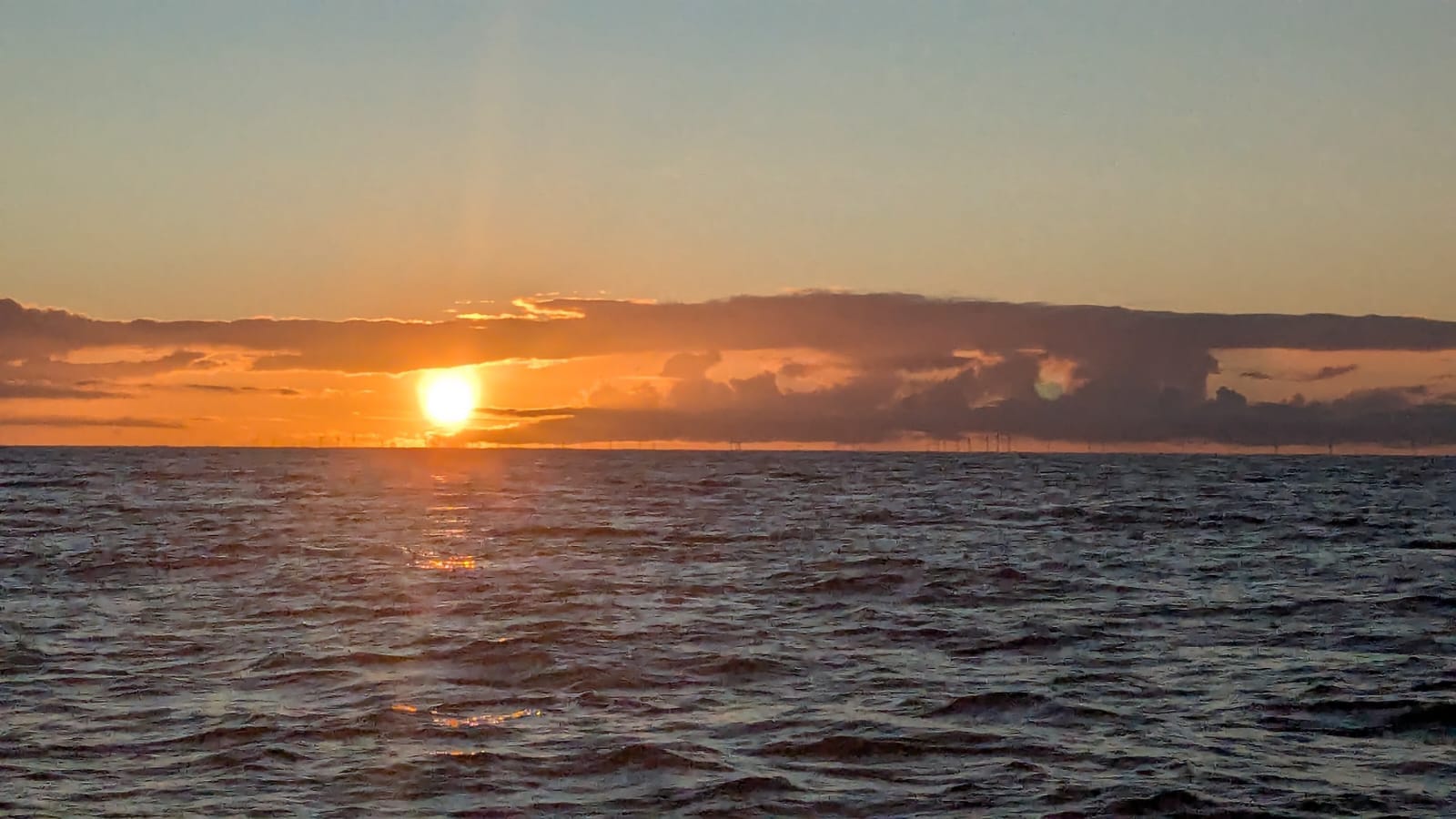
The welcome gentle warmth of the rising sun
As I approach Edinburgh twenty-four hours after leaving, the engine starts coughing and hacking, despite having a nearly full tank. She gives up her last sputtering cough and dies just as I pass the breakwater into the harbour. I only just manage to drift onto the pontoon and moor up again with the help of some friendly sailors that help catch my mooring lines. I immediately head down below and fall asleep, exhausted. A few hours later I return home, any hope of further sailing this season extinguished. Rigging broken, engine broken, my little ship barely functioning, my dream of a sailing adventure dashed by the capricious North Sea. I’m sorry, Kismet. We weren’t ready
In writing this memoir I initially had decided against a prologue. I wanted real-time continuity from page one until the end, allowing readers to be a part of the adventure the whole time. From me quitting my job and then fixing up my boat Kismet, until we set sail and circumnavigated Scotland, and then eventually returned, weatherworn and wiser for it.
But as I was editing after my first draft I realised the tone of the story is very different in part one, which deals with the burnout, quitting a job and working in a yard during cold winter nights to fix an engine and a broken boat. The rest of the story is about the sailing adventure: the waves and wind and wild; the drama and difficulties of sailing, as well as the beauty of it. So I thought I’d try writing a prologue of a short failed trip a year before the start of the main story in the memoir. The prologue sets a vivid scene and tone more similar to later in the book and hopefully brings readers in through the more immediate action. And I quite like it, I think it’s effective, and hopefully it works to draw readers in and give them more of an idea for what to expect from the whole memoir.
I would love to hear your thoughts around the pros and cons of prologues in both fiction and narrative non-fiction. Did this prologue draw you in and make you curious to read more? Let me know why or why not!
Please like and comment below if you enjoyed this first glimpse of my upcoming memoir, and subscribe for future posts.
Thanks for reading Writing to Save My Soul! Subscribe for free to receive new posts and support my work.
I have prologued, and de-prologued, and re-prologued, and re-de-prologued my own current work in progress several times. I think they work for some books and not for others. Like you say, if your story start point is slow, they can be a really good way to hook reader attention so they commit to the slower stuff. FYI though, someone I know recently told me he usually never reads prologues, which was a sobering thought. I'm hoping it's not that common.
I really like the style, with the mix of bird life, drama, emotional insight etc. For me, the prologue feels very self-contained though. It's got all the good narrative elements in it as a standalone, but it didn't leave me wondering what came next. I would say it needs to leave more unsaid, raise more questions so that I want to keep reading to find the answers. Have you thought about using a scene that comes from within the narrative itself ie from the start of Part II? Or just using the high stakes moments from this day and leaving yourself out there in the ocean with a broken forestay, and your reader has to read through the next x number of chapters to get back to that point and find out how you survive?
Hi Alexander, I do think this works well as a prologue. And I don’t think one can conclusively say that prologues are needed or unnecessary as a rule of thumb. Each writing project reveals itself quietly in the process of developing and it seems your instinct is correct about having the prologue based on your description.
I have always had a longing for sailing—growing up near waters and seeing sailboats, I immediately fell in love with them as a child and hoped to one day experience the great ocean in one. Many many years later, I have been fortunate enough to take small trips out on the Pacific. Part of me still longs for a bigger adventure at sea…perhaps it will still come. In the meantime, following your story seems like a lot of fun.


I have prologued, and de-prologued, and re-prologued, and re-de-prologued my own current work in progress several times. I think they work for some books and not for others. Like you say, if your story start point is slow, they can be a really good way to hook reader attention so they commit to the slower stuff. FYI though, someone I know recently told me he usually never reads prologues, which was a sobering thought. I'm hoping it's not that common.
I really like the style, with the mix of bird life, drama, emotional insight etc. For me, the prologue feels very self-contained though. It's got all the good narrative elements in it as a standalone, but it didn't leave me wondering what came next. I would say it needs to leave more unsaid, raise more questions so that I want to keep reading to find the answers. Have you thought about using a scene that comes from within the narrative itself ie from the start of Part II? Or just using the high stakes moments from this day and leaving yourself out there in the ocean with a broken forestay, and your reader has to read through the next x number of chapters to get back to that point and find out how you survive?
Hi Alexander, I do think this works well as a prologue. And I don’t think one can conclusively say that prologues are needed or unnecessary as a rule of thumb. Each writing project reveals itself quietly in the process of developing and it seems your instinct is correct about having the prologue based on your description.
I have always had a longing for sailing—growing up near waters and seeing sailboats, I immediately fell in love with them as a child and hoped to one day experience the great ocean in one. Many many years later, I have been fortunate enough to take small trips out on the Pacific. Part of me still longs for a bigger adventure at sea…perhaps it will still come. In the meantime, following your story seems like a lot of fun.